From Search to Booking in Fewer Steps: AI Is Redefining Travel Conversion
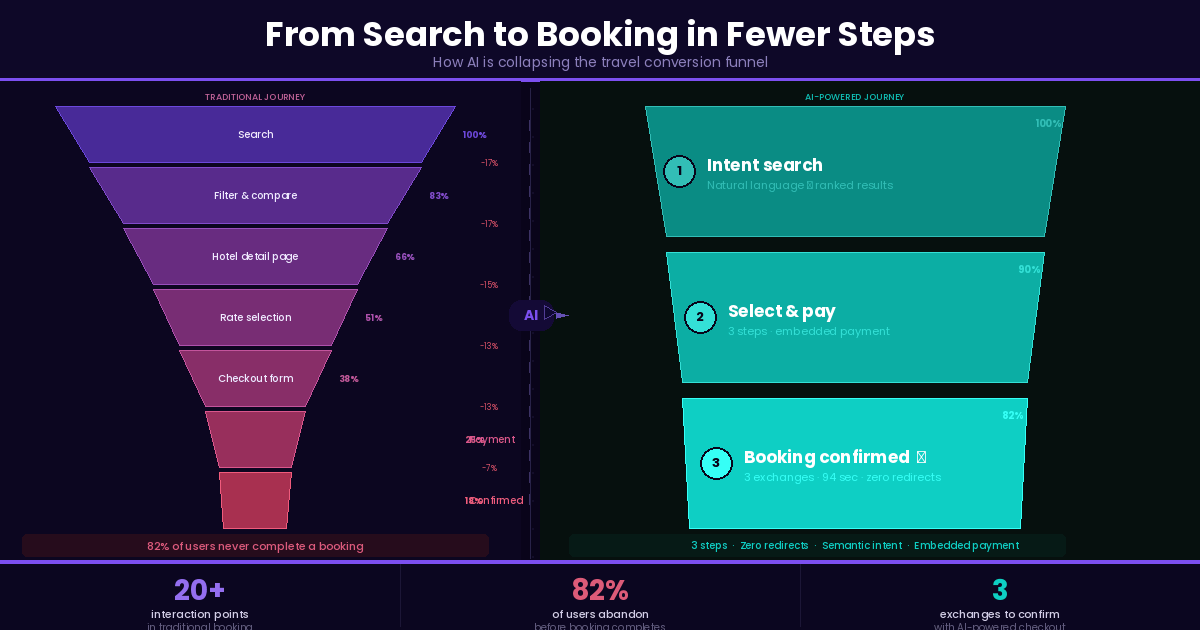
The conversion problem in travel isn't primarily a pricing problem or a supply problem. It's a friction problem. And friction compounds at every step, especially on mobile, where users abandon faster and re-engage less. The question isn't whether to reduce friction. It's where AI actually changes the equation versus where it's just repackaging the same journey with a new interface. The answer, increasingly, is that AI is doing something more fundamental: it's collapsing the number of steps required to go from intent to decision.
By Nuitée
Published February 26, 2026
The average hotel booking journey involves somewhere between 15 and 30 interactions before a transaction completes. Search. Filter. Compare. Click. Read the description. Leave the page to verify on Google. Come back. Get confused by the cancellation terms. Return to the list. Start again.
No one designed this journey on purpose. It accumulated.
The conversion problem in travel isn't primarily a pricing problem or a supply problem. It's a friction problem. And friction compounds at every step, especially on mobile, where users abandon faster and re-engage less. The question isn't whether to reduce friction. It's where AI actually changes the equation versus where it's just repackaging the same journey with a new interface.
The answer, increasingly, is that AI is doing something more fundamental: it's collapsing the number of steps required to go from intent to decision.
Where Bookings Actually Fail
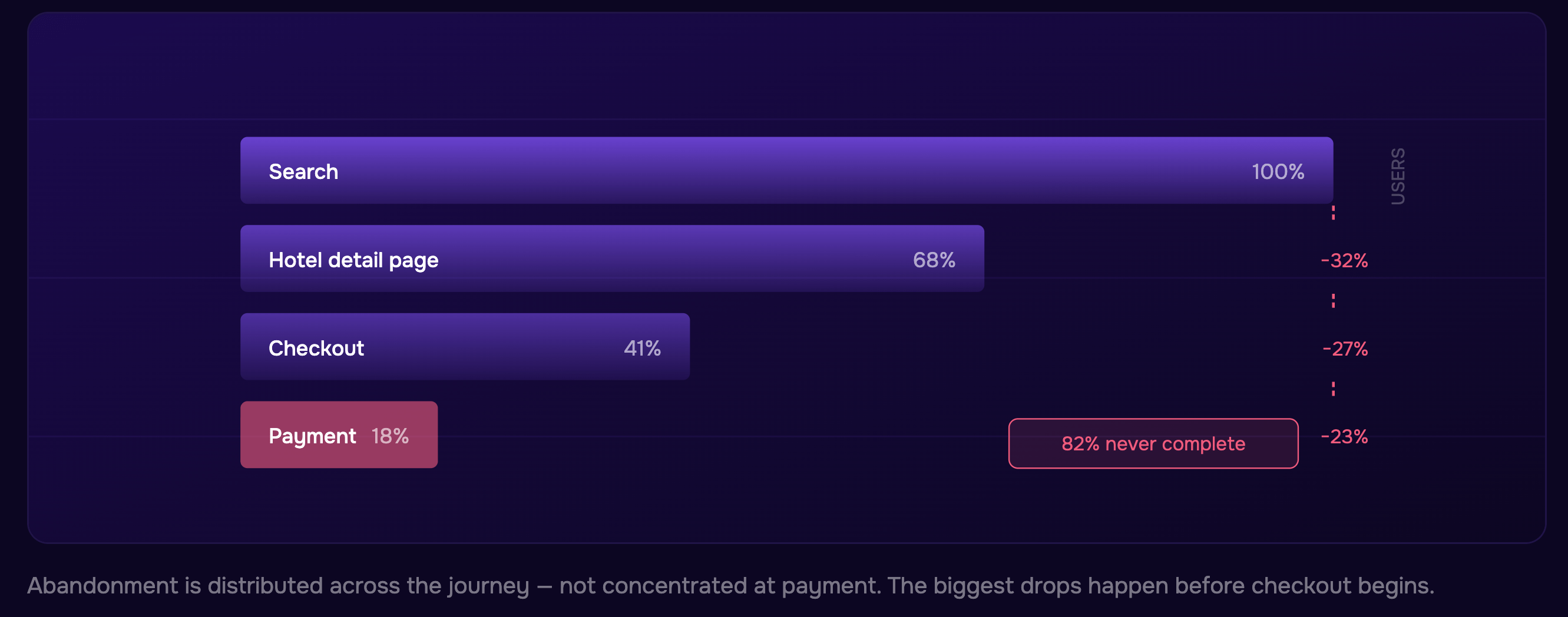
Look at where conversions break down, and a pattern emerges. It's rarely the final payment screen. Abandonment happens earlier: when search results feel irrelevant, when a hotel page doesn't answer the questions a user actually has, and when checkout introduces doubt at precisely the wrong moment.
Three moments define conversion in travel.
Discovery: Can users surface the right property quickly? Not more options. The right ones.
Confidence: Does the hotel page give users enough to decide, without pushing them elsewhere?
Completion: Is the checkout fast enough and trustworthy enough to close?
Most travel companies have iterated on UX at each stage independently. The bigger opportunity is connecting them with intelligence that reduces friction across the entire path, not just within each step.
Search That Starts With Intent
The starting point shapes everything that follows. If a user doesn't find the right property in the first few results, every subsequent interaction is a waste.
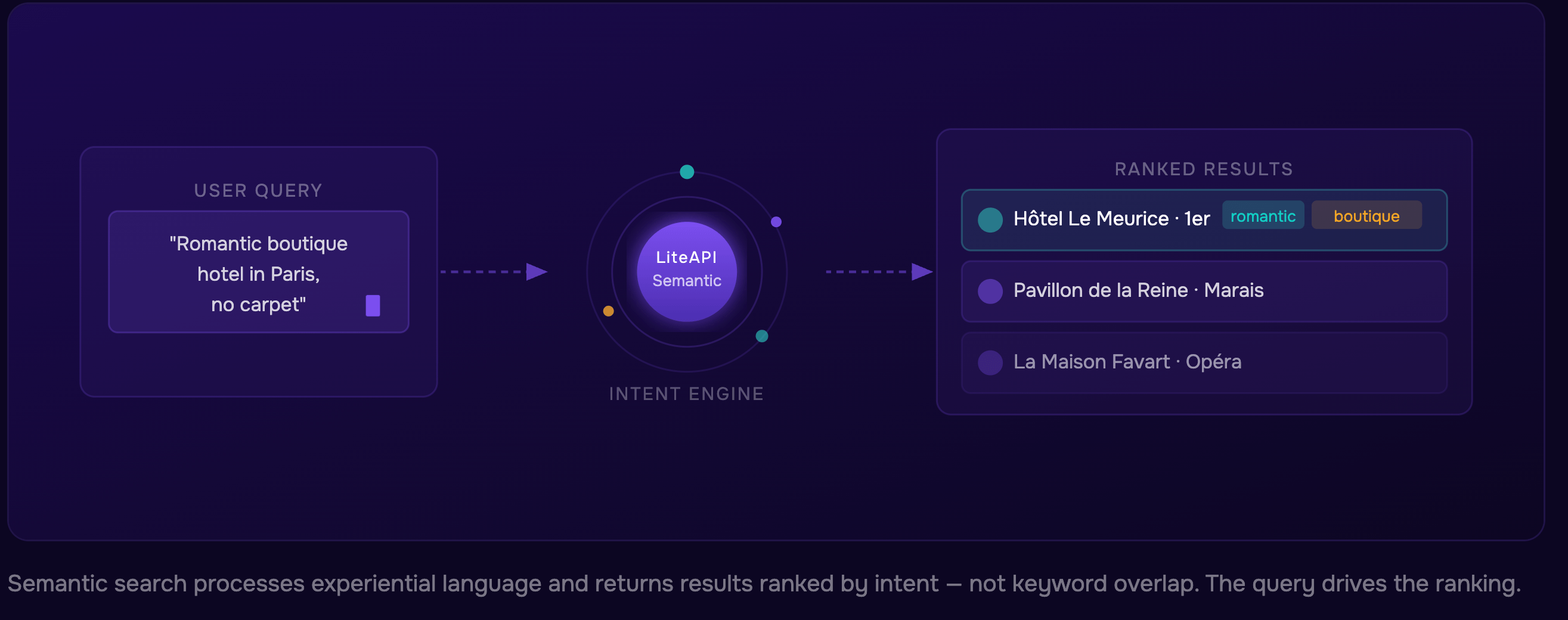
Traditional hotel search runs on attribute matching: location, dates, star rating, price range. The problem is that travelers don't think in attributes. They think in experiences.
"A quiet boutique hotel near the main museums, not too formal" is a perfectly reasonable brief. It maps poorly to any filter UI ever built.
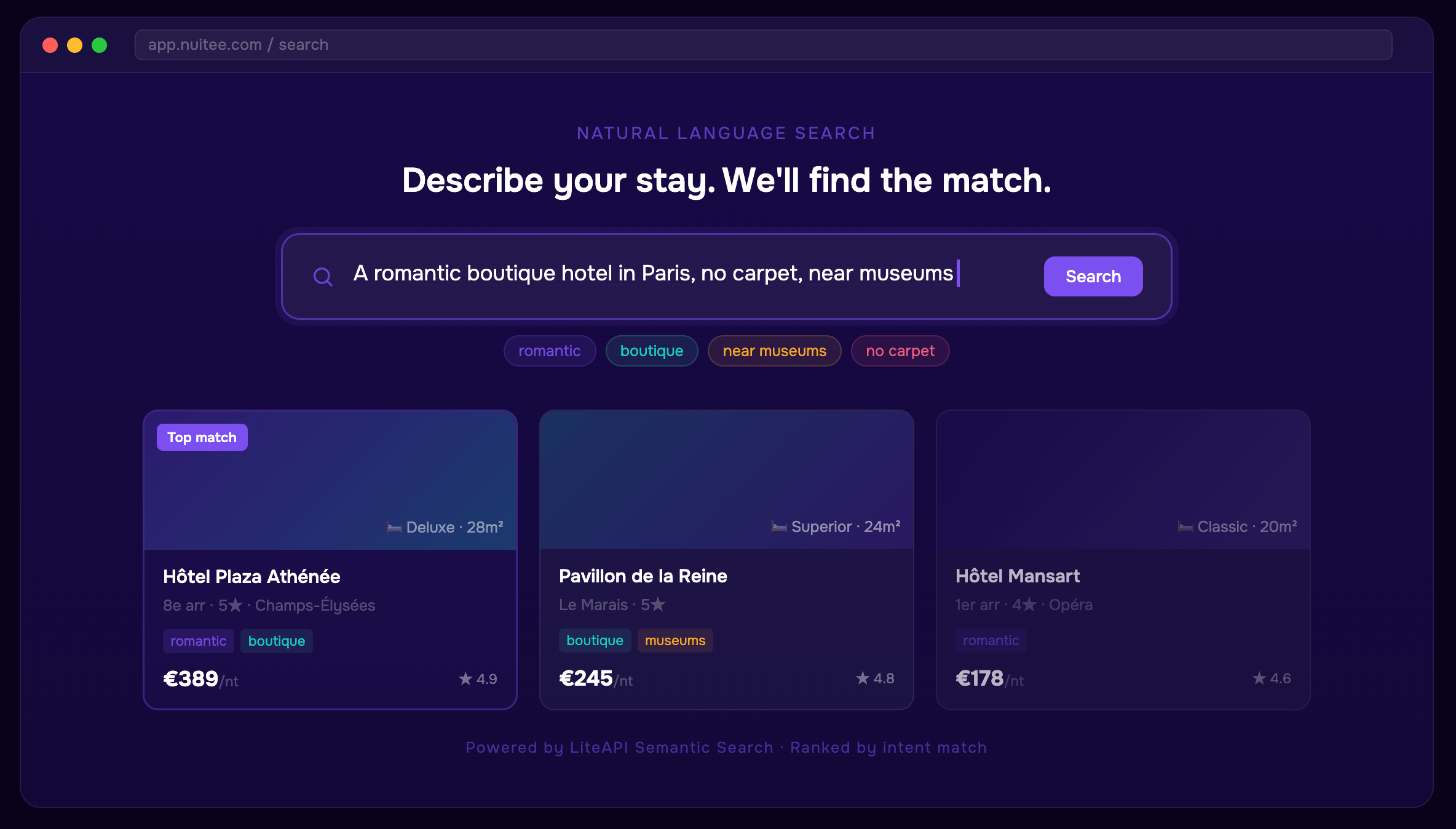
Semantic search changes the starting condition. LiteAPI's semantic search endpoint processes natural language queries and returns results ranked by intent match. A search for "romantic hotel in Paris with no carpet" surfaces properties that actually fit, complete with contextual tags and hotel IDs that feed directly into availability and pricing flows. The step between "I know what I want" and "here are the relevant options" becomes immediate.
There's a second moment where users typically lose confidence: once they land on a hotel detail page. They want answers that static content doesn't provide. Is there a major event near the hotel this weekend? What's the area actually like at night? The "Ask Hotel" endpoint addresses this gap by allowing applications to surface live, AI-powered answers to open-ended questions about a specific property. Users get context without leaving the booking flow.
Taken together, these capabilities address the same root problem: the gap between what users want to know and what traditional interfaces allow them to ask.
Content Quality as a Conversion Variable
Content is underrated as a driver of conversion, and it's rarely treated as infrastructure.
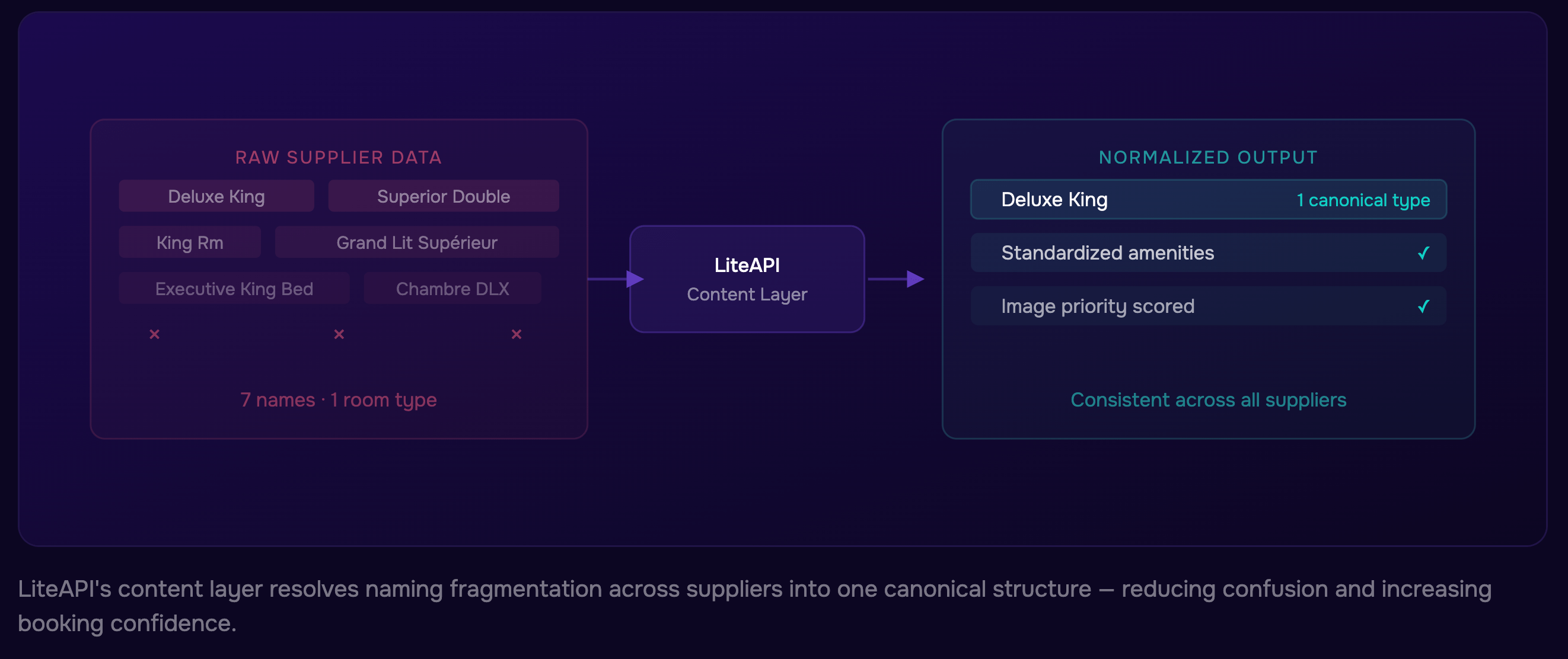
When room data is inconsistent, when images don't match descriptions, when one supplier lists a "Deluxe King" and another shows a "Superior Double" for the same physical room, users don't convert. They hesitate. Sometimes they leave.
LiteAPI's content layer normalizes hotel and room data across sources: matching room types, eliminating duplicates, cleaning content, and structuring it consistently across the entire inventory. The output isn't just cleaner data. It's pages that users can read, compare, and trust.
At scale, content quality is invisible when it works and destructive when it doesn't. A booking flow built on accurately mapped, enriched data converts measurably better than the same flow built on fragmented supplier content. For teams managing multi-supplier inventory, this is infrastructure work that directly affects the bottom line.
Clean content also unlocks richer presentation. AI-generated review summaries and intelligent image prioritization allow applications to surface the most relevant signals for different traveler profiles without requiring manual curation at the property level.
Checkout Is Where the Decision Gets Made
Even a fully qualified user can be lost in the final steps.
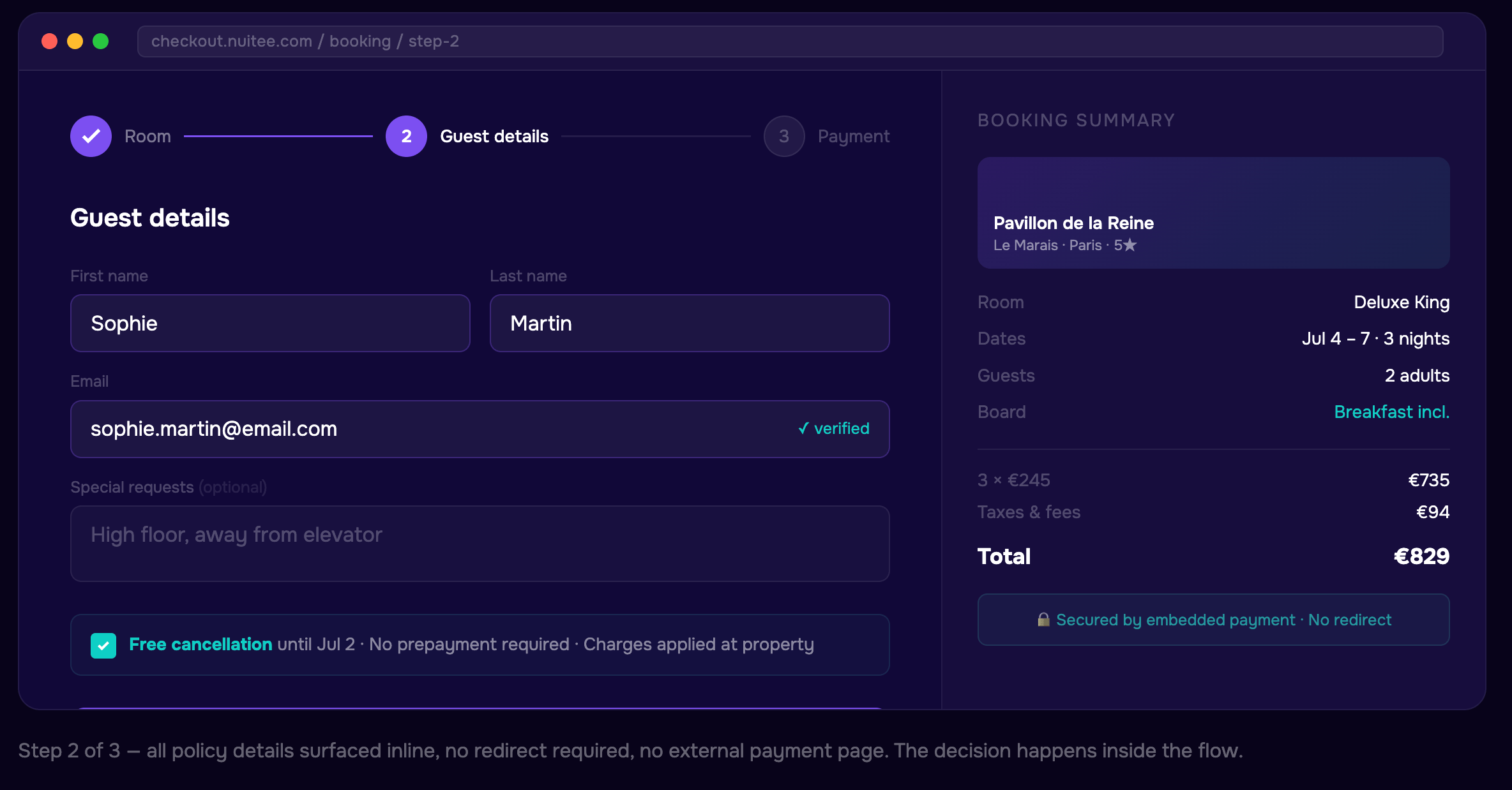
The booking and payment stage concentrates a lot of friction: policy confirmation, payment entry, final price validation, and what might be called "confirmation anxiety" — the moment a user wonders whether they should wait, check another site, or reconsider. Every extra field, every page load, every redirect is an opportunity for doubt to take hold.
A purpose-built booking engine eliminates the steps that don't need to exist and structures the remaining ones clearly. The LiteAPI checkout flow minimizes form fields, surfaces decision-relevant information at the right moment, and is optimized for both web and mobile. The goal is removing any interaction that doesn't directly move the user toward completing the booking.
Payment integration handles the other half. An embedded, Stripe-powered payment SDK processes transactions without routing users out of the flow. That continuity matters more than it might appear. Every redirect introduces risk. Every moment spent outside the booking UI is an opportunity to reconsider.
The combination of a streamlined booking engine and embedded payment narrows the gap between decision and completion. That's where conversion is actually determined.
AI Agents: Removing the Funnel Altogether
There's a further step beyond reducing friction in a traditional funnel: removing the funnel entirely.
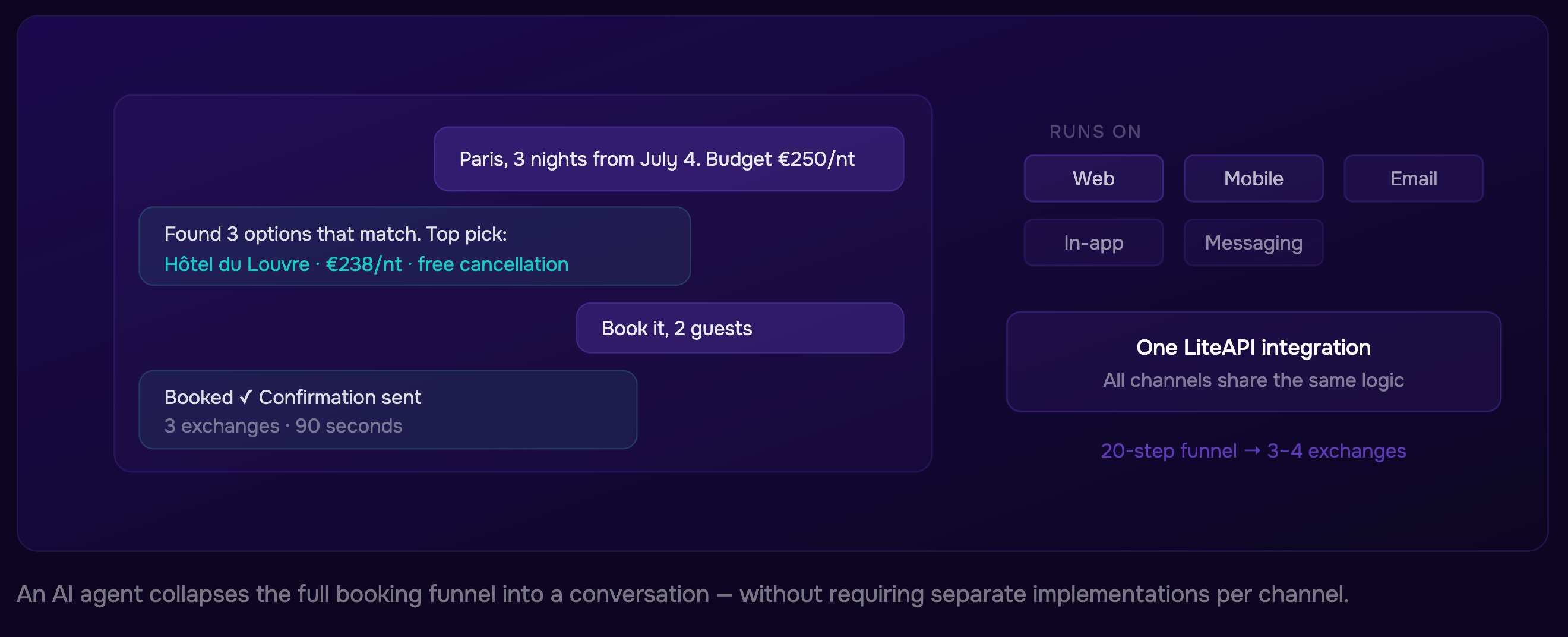
AI agents can handle the full booking journey through a conversation. A user states intent — budget, dates, location, style preferences — and the agent searches inventory in real time, surfaces relevant options, answers follow-up questions, and completes the booking without the user ever touching a traditional UI. For straightforward trips with clear requirements, this collapses a 20-step journey into three or four exchanges.
This is technically viable now. LiteAPI's REST-based architecture works across web, mobile, messaging, and agentic interfaces. A well-configured agent can call search, retrieve live rates, execute a booking, and handle a modification or cancellation within a single conversation thread. Multi-channel deployment means the same agent logic can operate in-app, on web, via email, or through a messaging platform, without duplicating the underlying booking infrastructure.
The conversion impact is direct. Less back-and-forth, faster resolution, better assistance at the moment of decision. For users who already know what they want, the journey becomes shorter. For users who are still exploring, the agent guides rather than overwhelms.
The Learning Loop: Analytics and Continuous Optimization
AI's role in conversion doesn't stop at the booking. The other side of the equation is understanding why users don't convert, and acting on it.
API Logs make the booking flow observable in a way that wasn't previously possible. Failed requests, availability gaps, rate mismatches, and behavioral patterns are now visible, searchable, and shareable across teams. Audit Logs add a second layer: tracking configuration changes and security-relevant events with AI-powered anomaly detection. Together, these tools turn a black box into a feedback system.
Dynamic Markup adds a real-time pricing dimension. Rather than applying fixed margins across all inventory, the system monitors competitor prices and adjusts dynamically: staying competitive on tight inventory, protecting margin where rates have more headroom, and avoiding lost bookings when market conditions shift. Pricing becomes an active variable in conversion strategy, not a configuration set and forgotten.
The result is a system that learns. Every interaction is data. Every data point feeds a better next result.
Conversion Is an Infrastructure Problem
The companies that improve conversion most in the next cycle won't just have better UX. They'll have better infrastructure.
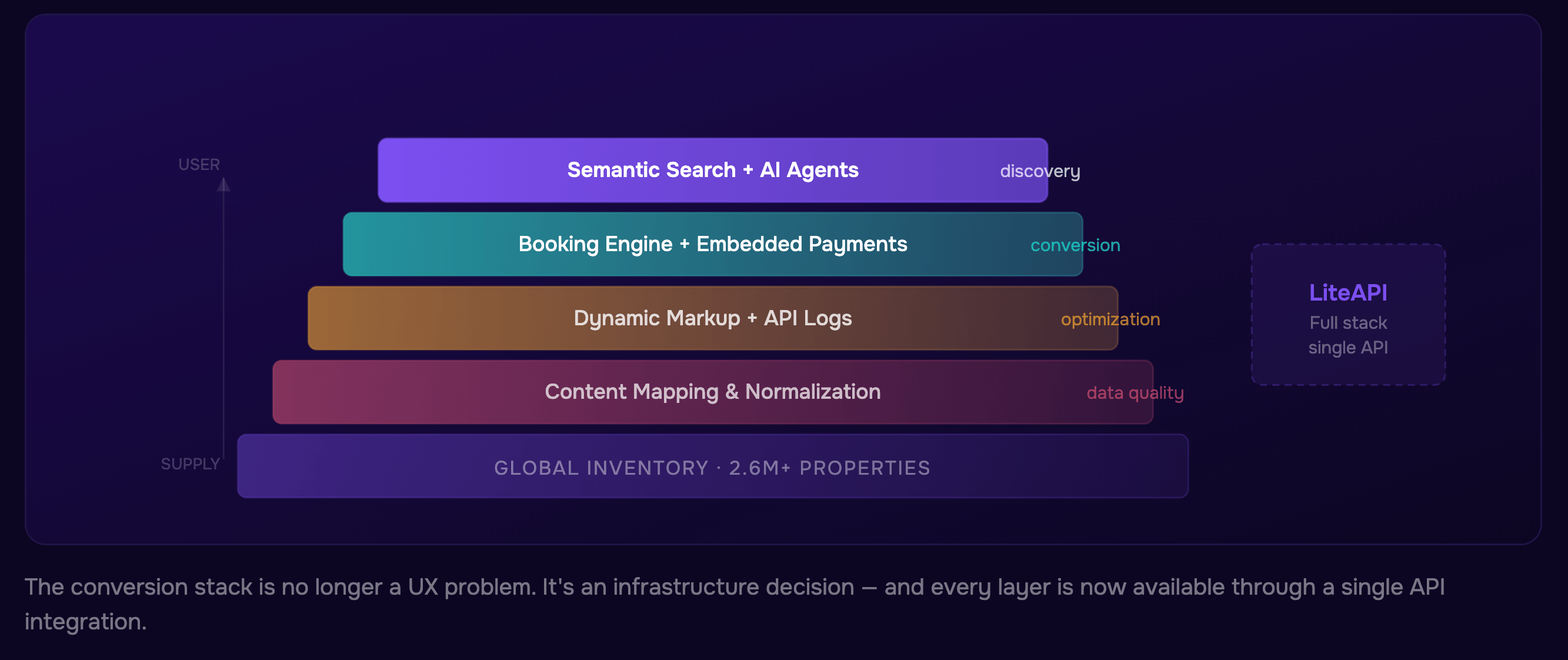
The components are now available and connectable: semantic search that surfaces relevant properties from intent alone, content normalization that builds trust at the hotel detail page, a streamlined booking engine, embedded payments, and observability that identifies exactly where the funnel breaks. Add AI agents on top, and the journey becomes shorter still.
The stack LiteAPI has assembled addresses each of these layers as a system: search and rates powered by AI intent, content mapping that eliminates supplier noise, integrated payment and checkout flows, and analytics that close the optimization loop. For travel companies rethinking their conversion architecture, that's where the leverage actually sits.
Explore the LiteAPI stack and see how it fits your booking flow at nuitee.com.