Rethinking Hotel Connectivity: From Data Pipes to Intelligent Infrastructure

More distribution channels have not made hotel distribution easier to manage. For most properties, they have made it harder. Better tools have raised the floor, not the ceiling. What shows up as a distribution problem – rate leakage, parity issues, low conversion – almost always originates upstream, in how systems connect and how data moves between them. "We've moved from fixing broken pipes to building ecosystems where connectivity actually fuels business growth."
By Nuitée
Published March 05, 2026
More distribution channels have not made hotel distribution easier to manage. For most properties, they have made it harder.
Better tools have raised the floor, not the ceiling. What shows up as a distribution problem – rate leakage, parity issues, low conversion – almost always originates upstream, in how systems connect and how data moves between them.
"We've moved from fixing broken pipes to building ecosystems where connectivity actually fuels business growth."
Yahya Fetchati, Head of Supply EMEA, Nuitee
The Old Problem: Broken Pipes and Stale Data
For most of the industry, connectivity success still means: the system works. Rates load.. Inventory is available.
That definition focuses on whether data moves, not whether it arrives accurate, consistent or commercially usable.
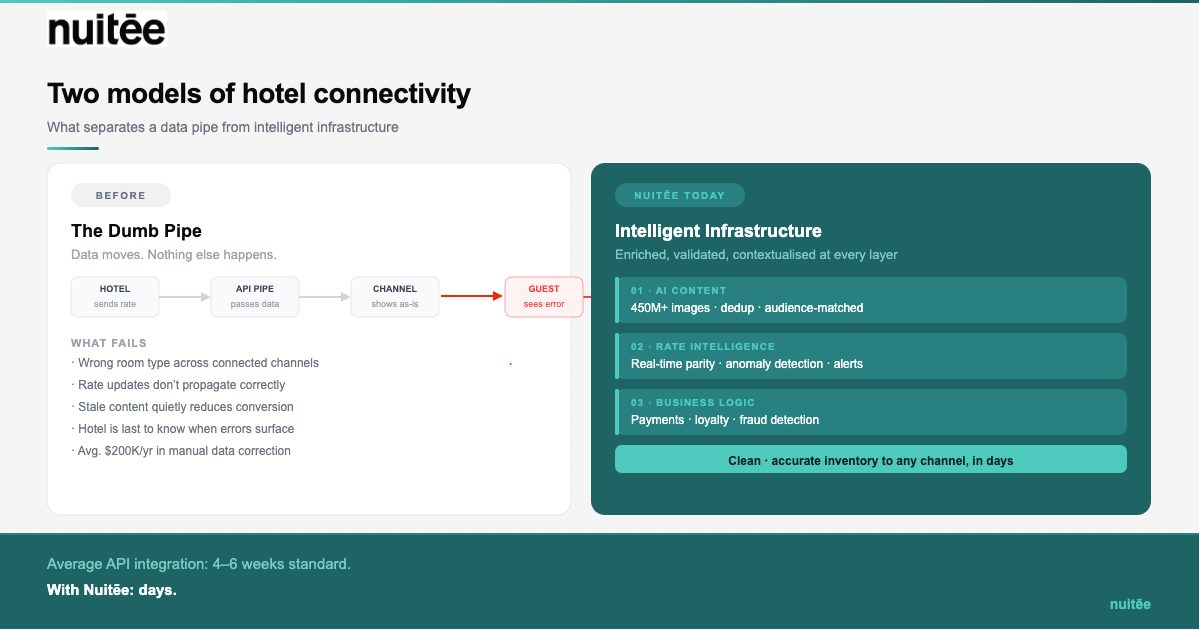
Getting a new distribution partner live still takes weeks. Industry data shows the average hotel API integration takes four to six weeks for a basic setup, and considerably longer when custom development is involved. Meanwhile, the content flowing through those integrations degrades at every step: room types that do not match, amenities out of sync, images that no longer reflect reality.
These are not exceptions. This is how the system behaves. And while they appear later as pricing discrepancies or conversion loss, they originate here – inside fragmented, loosely connected systems.
A 2025 study by Starfleet Research found that only 24% of hotels report having fully integrated technology systems. The 2024 Lodging Technology Study found that 69% of hotels still name integrating new technology with legacy systems as their number one challenge, ahead of pricing strategy, demand generation, and staffing. Skift Research estimates that up to 63% of hotel IT budgets go toward maintaining legacy infrastructure, leaving very little runway for anything that moves the business forward.
A PhocusWire survey reinforced the picture: 49% of hoteliers say they cannot access the data they need to make sound revenue and operational decisions, with 40% pointing directly to disconnected systems as the reason. As Puneet Mahindroo of COMO Hotels put it at WiT Singapore: "Our technologies interact in silos. Our customers don't."
That is not a legacy issue. It is the operational reality for most hotels.
The New Era: APIs That Think
The connectivity challenge has never really been about moving data from one place to another. Most systems can do that. The harder question is what happens to the data in transit.
A room type labelled differently across six connected channels. A rate that did not propagate correctly after the last update. A property description written for one audience and served to another. None of this triggers a system error. It shows up in lost conversion. By the time it’s visible, it’s no longer a connectivity issue. It’s a revenue problem.
Average hotel website conversion sits at just 1.5 to 3% across the industry (Formula, 2025). Research spanning 641 hotels and more than 111,000 guest reviews found content accuracy to be one of the strongest predictors of booking conversion. The hotels closing that gap are not doing it through better marketing spend. They are doing it through better data.
At Nuitee, this is built into the infrastructure itself.. AI systems have processed more than 450 million hotel images, cleaning, matching, and enriching property content continuously. Room types are standardised across suppliers. Duplicates are removed before they reach the booking layer. Property descriptions adapt to context: a corporate travel platform gets proximity to transport and meeting facilities, a leisure app gets local dining and amenities.
A static data feed cannot do that. It requires infrastructure that understands the inventory, not just carries it.
"Successful connectivity providers will no longer act as passive pipes. They'll become active, intelligent layers that enrich data, detect issues in real time, and simplify complexity for both hotels and distributors."
Yahya Fetchati, Head of Supply EMEA, Nuitee Once connectivity is treated as infrastructure – not plumbing – the role it plays changes. It stops being operational and starts becoming commercial.
Why Connectivity Now Means Opportunity
Revenue managers are asking different questions than they used to. Not "is the integration working?" but "what is this channel actually contributing, and at what cost?" Most connectivity infrastructure is not built to answer that because it was never designed to inform commercial decisions – only to enable distribution.
The hotels gaining ground treat connectivity as a commercial lever, not an operational task. That means
real-time visibility into rate performance across every connected partner,
anomaly detection before a pricing gap becomes a public parity violation, and
clarity which channels drive profitable revenue versus those that drive volume at the expense of it.
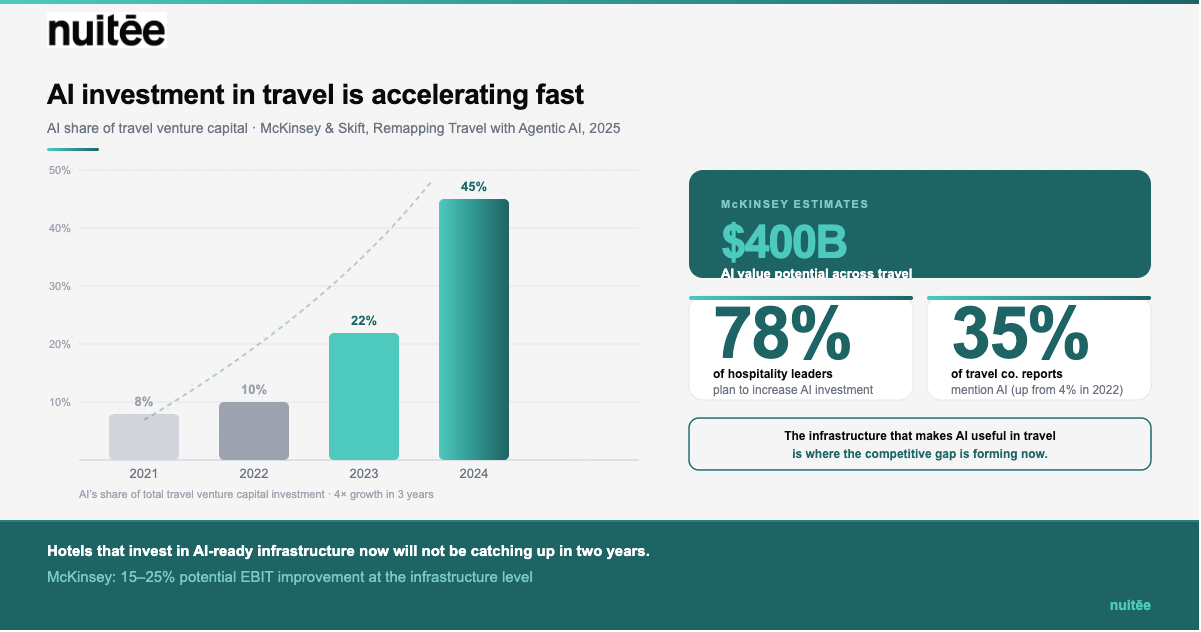
McKinsey estimates AI has the potential to generate $400 billion in value across the travel industry, with infrastructure-level deployment driving a potential 15 to 25% EBIT improvement. Investment in AI-focused travel technology has surged from 10% to 45% of all travel venture capital since 2023 (McKinsey and Skift, Remapping Travel with Agentic AI). The gap between hotels with intelligent infrastructure and those still managing distribution reactively is widening every quarter.
AI: The Invisible Engine of Modern Travel
Good AI in hotel operations runs in the background.
Rate accuracy monitoring.
Content validation.
Demand forecasting.
Anomaly detection. Problems surface before anyone looks for them.
The State of Distribution 2025 (NYU, HEDNA, RateGain) found that four in five hotels still spend up to two full working days every week compiling manual reports. Separate research puts the average annual cost of manual data entry and duplicated communications at $200,000 per property (Akia, Top Hospitality Challenges 2025). That is time and budget spent on what has already happened, not on what is happening now.
Nuitee's infrastructure runs this intelligence layer continuously across rate monitoring, content enrichment, and booking performance. Hotels and distribution partners within the ecosystem benefit from it without needing to build or manage any of it in-house.
From Infrastructure to Ecosystem
Nuitee raised $48 million from Accel to expand this infrastructure. Today, it connects 3 million properties through a single API. Hotels connected through that ecosystem reach: - OTAs, - loyalty programmes, - fintech platforms, - super apps, - emerging AI-powered booking surfacesThe quality of connectivity infrastructure determines what commercial options are available on top of it. Good infrastructure expands distribution. Poor infrastructure multiplies errors.
Success is no longer measured by how fast data moves but by what happens when it arrives.
Where the infrastructure gaps show up most visibly is in distribution: rate leakage, parity failures, and the operational cost of holding a fragmented system together. Distribution is simply where the consequences become visible. The root cause sits one layer below.